Commercial Floor Sanding in Brockley, SE4
Where sanding forms part of a wider programme, we can also assess Commercial Floor Restoration in Brockley, planned Commercial Floor maintenance in Brockley and periodic Commercial Floor Polishing in Brockley. The specification is based on timber type, traffic loading, contamination, existing coatings and how quickly the area needs to return to service.
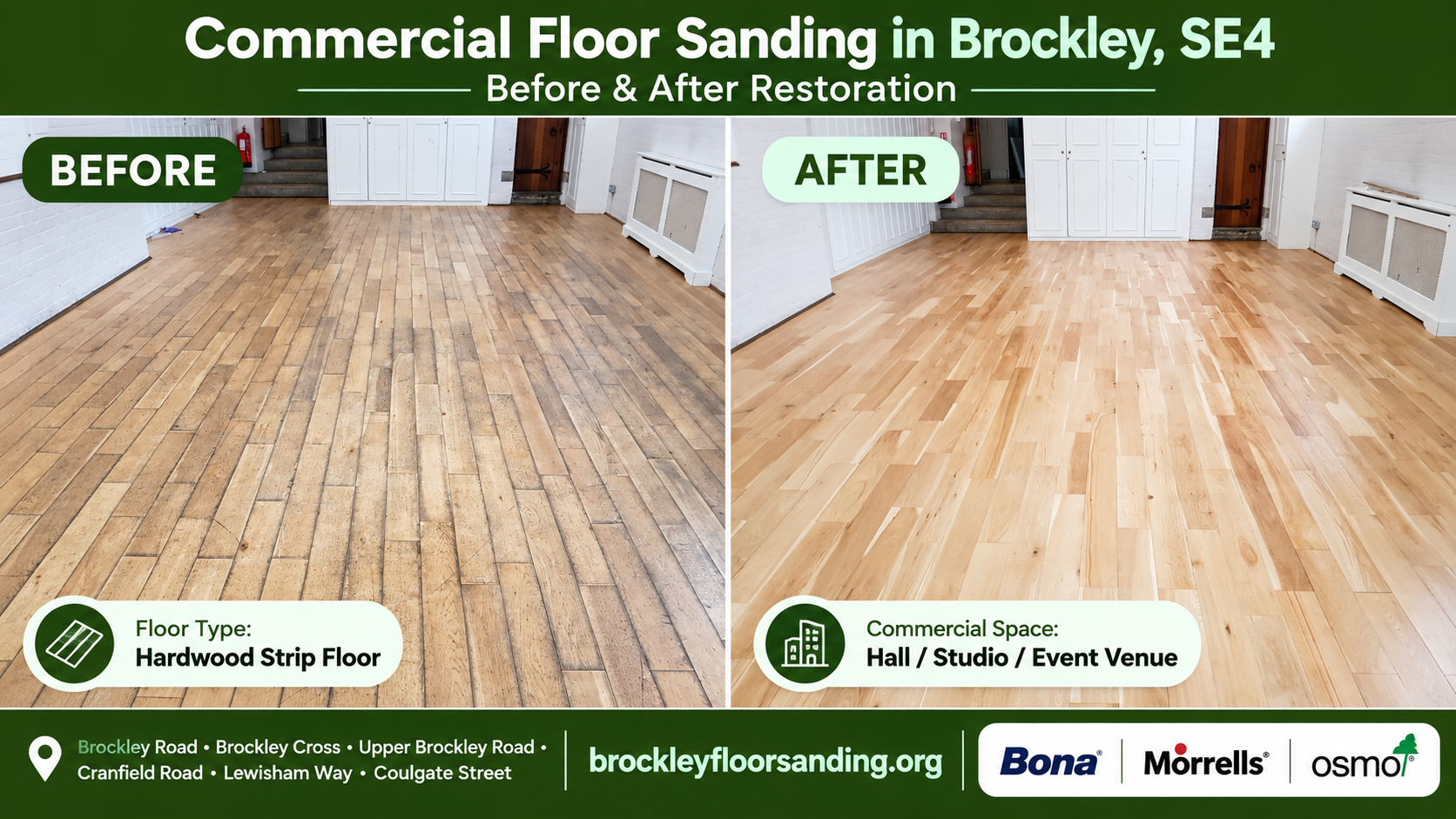
Commercial hardwood strip floor sanding and restoration in Brockley, SE4, showing the transformation from a worn commercial floor to a freshly sanded and refinished surface.
Commercial Timber Floors in Brockley Need a Different Approach
Brockley has an unusual mixture of commercial premises. We come across converted Victorian properties around the Brockley Conservation Area, older shop units along Brockley Road, premises around Brockley Station and Coulgate Street, institutional buildings towards Lewisham Way, and later commercial units that have had several different floor coverings fitted over the years.
Older buildings around Cranfield Road, Upper Brockley Road and the streets surrounding the conservation area can contain original pitch-pine boards, oak strip, mosaic parquet and later hardwood installations laid over altered substrates. Before taking a sanding machine to any of them, we establish what timber is present, how much usable wear layer remains and what previous contractors have applied.
That matters with floors such as quartersawn oak, pitch pine and teak. They sand differently, absorb stains differently and do not all respond well to the same filler, primer or lacquer system.
Sites We Work On
Our commercial work covers private offices, coworking and serviced offices; shops, boutiques, showrooms and shopping-centre units; restaurants, cafés, pubs and takeaway premises; factories, workshops and manufacturing areas; storage units, distribution centres and delivery depots.
We also restore floors in gyms, cinemas, studios and event venues; hotels, hostels and serviced accommodation; clinics, dental practices and treatment rooms; and educational or community premises including schools, colleges, universities, academies, churches, mosques and temples.
Why Domestic Sanding Methods and Shop-Bought Polishes Fail on Commercial Floors
A floor carrying several hundred pairs of shoes a day needs a different finish specification from a bedroom. Applying domestic polish over a worn lacquer normally gives a temporary shine while leaving damaged coating, ingrained contamination and weak adhesion underneath.
Commercial restoration starts by finding out why the surface has failed. Common causes include excessive water during cleaning, alkaline detergents, chair castors, grit at entrance points, movement between parquet blocks, moisture from the substrate and coatings that were never suitable for the traffic level.
- Loose boards and parquet: movement eventually breaks filler and surface coatings and can create raised edges or trip points.
- Open joints: food debris, cleaning residue and dirt collect between blocks, particularly in cafés, bars, schools and healthcare settings.
- Moisture ingress: elevated subfloor moisture can cause cupping, adhesive failure, black staining and repeated movement.
- Loss of slip resistance: highly polished or contaminated finishes can become problematic at entrances, bars, serving areas and other locations exposed to moisture.
- Incorrect coatings: soft single-component finishes can wear rapidly under castor chairs, queues, gym traffic and repeated commercial cleaning.
- Over-sanding: aggressive sanding without checking the remaining timber can permanently damage engineered boards, parquet tongues and thin historic flooring.
- Contaminated timber: wax, silicone, oil, grease and old maintenance products can interfere with the adhesion and curing of modern lacquer systems.
Our Commercial Floor Restoration Process
Step 1: Subfloor Audit & Moisture Testing
We start with the floor rather than the sanding machine. The survey checks board stability, parquet adhesion, hollows, deflection, previous coatings, damaged thresholds, service penetrations and the condition of the substrate beneath any accessible sections.
Where moisture is a concern, hygrometer checks or appropriate timber and subfloor moisture readings are taken before sealing the surface. Sanding a visibly dry floor while ignoring moisture underneath can leave the client with cupped boards, failed adhesive or a whitening lacquer film several weeks later.
We also identify the timber and establish whether it is solid board, engineered flooring, parquet, reclaimed material or a mixed repair. Quartersawn oak, resinous pitch pine and naturally oily species such as teak require different preparation and coating decisions.
Step 2: Timber Repairs, Re-bonding & Resin Gap-Filling
Loose parquet is lifted where necessary, old brittle adhesive is removed and blocks are re-bonded using a suitable flexible system. On appropriate substrates we use modern silane-based flexible parquet adhesives, selected for movement tolerance and, where required, EC1 Plus low-emission classification.
Damaged boards are repaired or replaced with timber selected to suit the existing species, dimensions and age of the floor. In older Brockley properties this may mean matching wide pitch-pine boards or carrying out local parquet repairs rather than introducing obviously modern material into a mature floor.
Fine stable gaps can be filled using a resin-slurry system produced with clean sanding dust from the floor itself. Wider or movement-prone joints are assessed separately because forcing rigid resin into every gap is poor practice; some require timber slivers, individual repairs or a flexible joint solution instead.
Step 3: HEPA Dust-Controlled Sanding & Surface Preparation
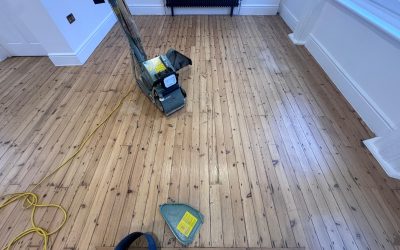
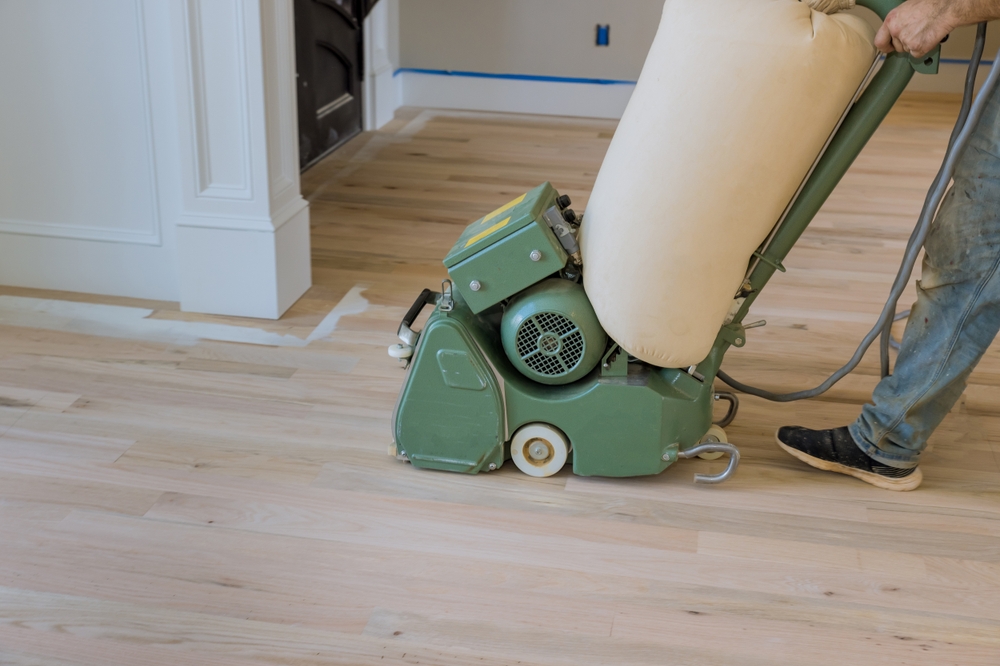
For open commercial areas we commonly work with professional belt-sanding equipment such as the Lägler Hummel, followed by edging and progressively finer finishing passes. Abrasive sequence is chosen according to coating thickness, timber hardness and floor condition rather than automatically starting with an unnecessarily coarse grit.
Machines are connected to high-efficiency extraction, with HEPA H14 filtration used where the site specification calls for controlled fine-dust capture. No sanding operation is literally dust-free, but correct extraction, machine maintenance and containment make a substantial difference in offices, clinics, schools, hospitality premises and other occupied buildings.
Between sanding stages we check for chatter marks, cross-grain scratches, damaged filler and contamination. Corners, radiator zones, thresholds and edges are finished properly rather than leaving coarse edging marks to become obvious once stain or lacquer is applied.
Step 4: High-Traffic Finishes — 2K Lacquers, Hardwax Oils & Anti-Slip Systems
The finish is specified around the building’s use. For heavily trafficked offices, hospitality areas, schools and public-facing premises, a commercial 2K waterborne polyurethane is often appropriate because the cross-linking catalyst produces a tougher cured film than a basic domestic single-component lacquer.
Hardwax oil may be preferable where the client wants a more natural appearance, easier localised maintenance or a finish suited to particular heritage timber. It is not automatically the right choice for every restaurant, gym or high-throughput entrance, so cleaning regime and expected contamination need to be considered before specification.
Where slip risk is part of the brief, we can specify coatings and maintenance methods around the required slip-resistance strategy rather than assuming that a matt-looking floor is safe. Pendulum slip testing was historically undertaken to BS 7976-2; the current standard is BS EN 16165:2021, and testing can be specified where the client’s risk assessment, insurer or facilities team requires documented performance.
Restaurants, clinics, schools and similar occupied premises may also require lower-emission materials. Where the specification demands it, we can select compatible primers, adhesives and finishing products carrying recognised low-emission classifications such as EMICODE EC1 Plus.
Step 5: Aftercare & Commercial Maintenance Protocols
A newly restored floor can be damaged quickly by the wrong cleaning product. We provide practical guidance covering entrance matting, chair protection, damp-cleaning methods, pH-appropriate products, maintenance coats and the point at which the floor should be recoated before traffic wears through to bare timber.
For larger premises, planned maintenance is normally cheaper and less disruptive than waiting for the whole coating system to fail. A clean, abrade and maintenance coat carried out at the right stage may postpone another full sanding cycle and preserves more of the original timber.
Examples of completed floor finishes and restoration work can be viewed in our floor sanding gallery. For indicative sanding, sealing, gap-filling and repair costs, see our floor sanding prices; larger commercial sites are quoted individually following assessment.
Commercial Floor Sanding Around Your Opening Hours
Closing a working business for several days is often more expensive than the floor repair itself. We therefore plan access, noise-producing operations, coating windows and reopening times before work starts.
Night work, weekend work and sectional phasing are all possible where the floor layout and coating system allow it. Cure time must still be respected: a lacquer may be touch-dry long before it has developed enough strength for desks, restaurant furniture, wheeled loads or heavy public traffic.
| Working Method | Operational Benefit | Typical Facility Suitability |
|---|---|---|
| Overnight / Out-of-Hours | Noisy sanding and coating can be carried out after staff or customers leave, with agreed areas protected before reopening. | Offices, retail units, restaurants, cafés, clinics, gyms and reception areas. |
| Weekend Phased | Provides a longer uninterrupted sanding and curing window and can reduce disruption to weekday operations. | Schools, colleges, offices, dental practices, studios, showrooms and community buildings. |
| Sectional Phasing | Allows part of a larger building to remain operational while defined zones are restored in sequence. | Hotels, serviced offices, warehouses, event venues, larger shops, institutions and multi-room premises. |
Furniture reinstatement, pedestrian traffic and full operational use are programmed according to the manufacturer’s actual recoat and cure data, ambient temperature and ventilation. We do not tell a client that a floor is ready for heavy traffic simply because the surface feels dry.

Herringbone parquet floor sanding and restoration in a Brockley commercial hall, club or function room, revealing the rich timber colour and renewed finish.
RAMS, COSHH and Site Safety for Commercial Floor Sanding
Commercial sites normally require more than a verbal description of the work. Where requested, the project is supported by site-specific RAMS covering sanding equipment, electrical leads, dust control, access segregation, manual handling, chemical products, noise and interaction with staff or the public.
COSHH information is considered for lacquers, catalysts, adhesives, fillers, stains and cleaning chemicals used during the works. Product choice is also discussed where an occupied school, clinic, hotel, office or hospitality site has particular VOC, ventilation or reopening requirements.
Slip performance must be considered in context, especially around entrances, toilets, bars, serving areas and routes exposed to wet footwear. Where formal verification is required, pendulum testing can be incorporated into the specification using the current BS EN 16165 method rather than relying on appearance or a vague description such as “anti-slip”.
Restoring Brockley’s Older Commercial Timber Floors
A large part of Brockley’s character comes from its nineteenth and early twentieth-century building stock. Converted Victorian houses, older shopfront premises and Edwardian institutional buildings can contain timber that has already survived a century of alterations, plumbing work, partitions, heating changes and repeated floor coverings.
That is why we do not automatically replace stained boards or loose parquet. Sound original timber can often be repaired, cleaned back and integrated with reclaimed material, provided the substrate is stable and enough usable timber remains for controlled sanding.
Premises close to Brockley Road, Brockley Cross, Coulgate Street, Cranfield Road and the wider conservation area can also present awkward access, restricted loading and neighbours immediately above or beside the work area. Those details are considered when arranging machinery, extraction, waste removal and out-of-hours sanding.
What We Need Before Quoting a Commercial Floor
An initial estimate can often be started from photographs, video and a basic floor plan showing approximate square meterage. Useful images include the whole floor, damaged areas, thresholds, loose parquet, exposed edges and close-ups of the existing coating.
For substantial or technically uncertain work, we follow this with a physical site survey. That allows us to inspect access, power, moisture conditions, timber construction, repairs, furniture movement, working hours and the finish required before issuing the final scope.
The quotation separates the agreed work rather than hiding repairs inside a single vague square-metre figure. Where sanding, board replacement, parquet re-bonding, gap filling, staining or specialist coatings are required, these can be identified clearly so the facilities manager or business owner knows what has been allowed for.
Commercial Experience, Proper Site Preparation and Accountable Work
Commercial floor restoration depends as much on planning as sanding skill. Operatives attending controlled sites can provide relevant CSCS credentials where required, and work is undertaken with appropriate commercial liability insurance for the agreed scope.
Before machinery is unloaded, we want the access arrangements, working zones, finish system and reopening programme understood by both sides. On occupied sites that means liaising with the responsible manager so staff, customers, pupils, patients, residents or contractors are kept away from active sanding and curing areas.
The objective is straightforward: repair what needs repairing, remove failed coatings without taking unnecessary timber away, apply a fit-for-purpose finish and hand the area back on an agreed operational schedule.